Week 6: Psychoanalysis & the Gaze
Movie magic is the thrill of seeing
a movie and feeling as if the viewer was in the movie. Action gives adrenaline rushes; dramas make the
viewer’s heart sink and comedies make other’s eyes water. Movies invite people
into a world they never knew and allow them to be someone else. But the only
way movies allow voyeurism is by playing with human instincts and emotions that
are vital in the viewers. Laura Mulvey wrote “Visual Pleasure and Narrative
Cinema” to throw a rock into the lens of the camera. Everyone takes pleasure in
looking at something even more pleasure when the subject being looked at is
sexual. The person is no longer looked at as a person but as something to possess.
Cinema has captured this look and continue to leech off this mental behavior especially
in white males. This possess can be seen in female roles. Not apart of the plot
kept outside of the action yet still something to look at and forward to seeing
for gratification. Or how movies play into egotism. Male characters are in
control of their environment and can force their will onto events. This is what
the ego is for the false sense of being in control of events even when unconsciously
the events are uncomfortable. These is the tropes in cinema Mulvey rebukes in her
writing. Since the ego is needed to control what is around
them women in film need to be controlled too. Females have the power to induce
anxiety of castration to males. “ She also connotes something that the look continually
circles around but disavows: her lack of penis, implying a threat of castration
and hence unpleasure” Mulvey writes and them applies to overcome this anxiety
males in movies and in real life must
have power over women. Mulvey arguments are
well backed with Freudian theories of socophillia and castration complex. Along
with Lacan’s theory of the mirror stage. Voyeurism plays into these philosophies
on the outside looking in is an uncomplicated way to live. The viewer has control
over the story they can make it up and even if the story does not fit there is
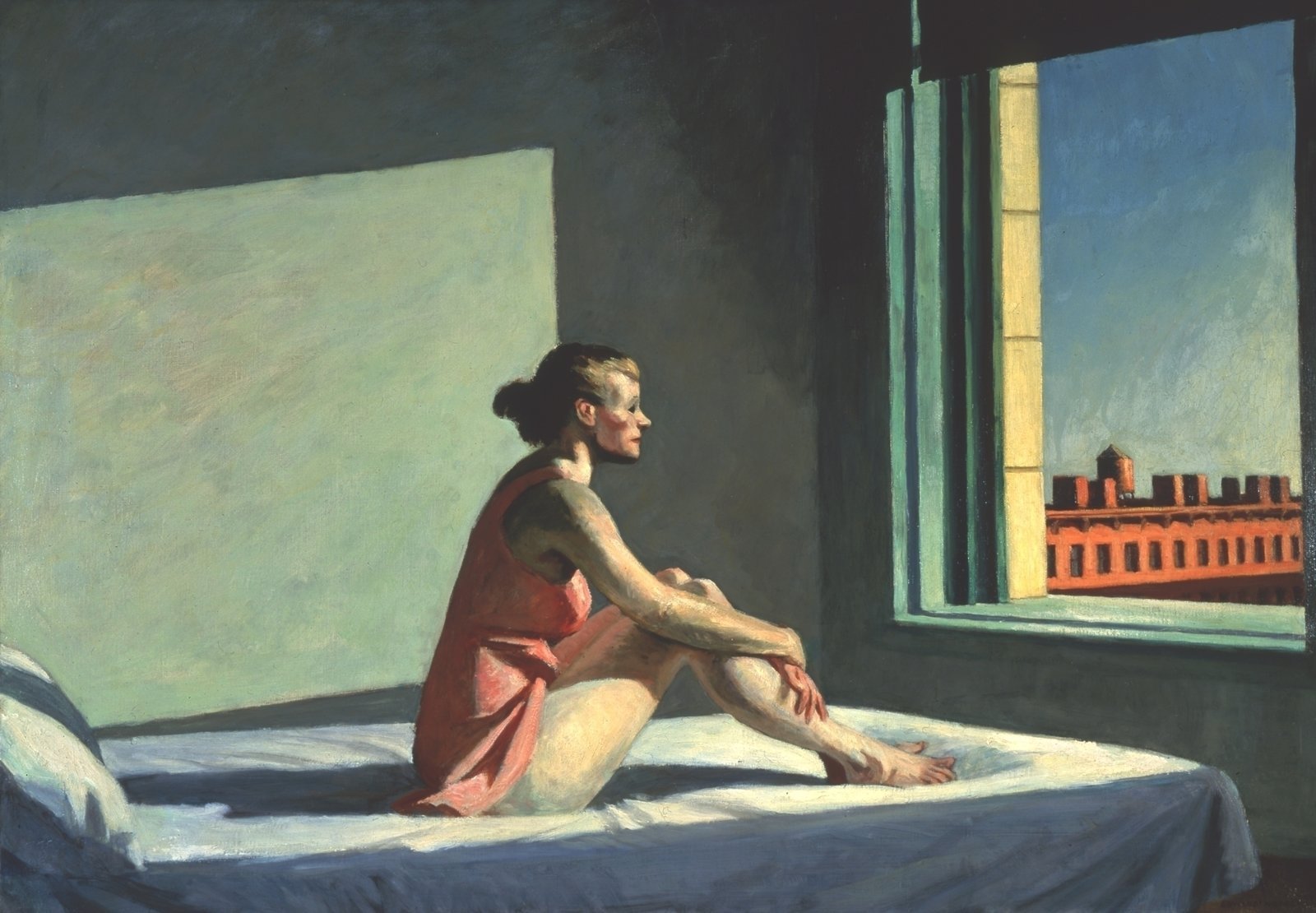
no harm to them. Edward Hopper’s Morning Sun also has the sense of voyeurism
not knowing what the women is thinking, but also how the women is isolated. She
is relegated to the male view and the male’s dominance over her being. Women’s image
is not in control by the female gaze.
Mulvey, Laura. “Visual Pleasure and Cinema Narrative .” Columbia University Archives . Screen. Accessed 2020. http://www.columbia.edu/itc/architecture/ockman/pdfs/feminism/mulvey.pdf.
Then & Now. “Jacques Lacan - The Mirror Stage.” Youtube, September 22, 2016. https://www.youtube.com/watch?v=agTYUU4gTOo&t=2s.


Hi Rachel!
ReplyDeleteYour writing flows so nicely, I love how everything blends together. I thought your writing was very well thought out, however I think the statement you made about everyone taking pleasure in looking at something may be a little too vague. Since you talk about the male gaze and mention the female gaze, how much do you think the idea of the gaze has changed since Laura Mulvey's initial writing?
Thank you, Jamie,
DeleteIn my statement about everyone taking pleasure in looking was about the basic pleasure that sight can bring us. Having sight offers a lot of input that the world has to offer. It allows us to put together our own opinions about what we see, whether it be ugly, beautiful, plain, or exciting. I personally do not think the gaze has changed a lot over the time Mulvey wrote this essay. It takes a consciousness effort to change the way one thinks. It is going to take a long time for those efforts to become habit and change the way we all think.
The piece you chose to feature is very interesting, as the woman isn't drawn in a provocative pose or to appeal to another persons fantasy. She just woke up and appears to be reflecting on something. How do you think Freud would react to how women are portrayed as having power over men in some of our more modern stories?
ReplyDeleteHello, Soarxisscared,
DeleteI chose, Edward Hopper’s Morning Sun because the woman in the painting is his wife. Hopper had the habit of controlling his wife. In the end she sacrificed her own career to manage Edward’s career. He would also constantly degrade her artwork and would not allow her to show it. She was regulated to being viewed the way her husband saw her. Freud’s theories have the overall theme of misogyny so Freud, would not be fond of the modern movies where women have power over man.
Hey Rachel, I would definitely agree with the points that you make about women in films, and how they are generally written to be seen not heard. While I agree with the the content of your post, I would suggest cleaning up the grammar and the flow of the sentences just a little more to make your good ideas more coherent. Overall you did a good job, I’m just curious as to your thoughts on women in other media like television or video games, among others.
ReplyDeleteMiguel,
DeleteI belive that the way women are portrayed in movies is the same way they are portrayed in video games, television, and all other medias. When women do have a strong lead in those alternative medias, they are given masculine traits. Which tends to diminish the roles of females since the most prominent characteristic are not nurturing which usually represent feminist qualities.
This seems like your best piece yet, I would break this up a bit though. It seems shorter than it actually is being just one paragraph. Did Hopper describe what she was thinking or is it just up for the viewer's interpretation?
ReplyDelete