Reading Response: Social Justice and Inclusion in Musuems
Museums
are a public institution, where all should feel welcomed in participating in
what is being provided. Museums have notoriety, there are many museums people
have heard of but never been too. Such as the museum of modern art, the metropolitan,
Smithsonian, and museums of science. However, museums have a glaring problem that
needs to be addressed. Museums are not welcoming all people that are a part of
the public forum. In articles like “Inclusion in Museums: A Matter of
Social" Justice by Rose Kinsley and " Accountability and Disposal:
Visual Impairment and the Museum" by Kevin Hetherington they expose this problem.
Kinsley article gives data ,“ in 2008, the National Endowment for the Art
reported that non-Hispanic whites were over- represented among American adults
art museums visitors ( 78.9% of visitors, while just 68.7% of the US population)
while Hispanic and African Americans were significantly underrepresented.” Kingsley
sugguest it may be this way because minorities do not feel represented in museums.
There could be another factor on why minorities do not experience museums the
same way as whites. Treatment of
minorities in the museums. Staff can make them feel out of place when they are
watched and frequently checked upon. Which leads to another issue, museums do
not seem to care about obtaining visually impaired audiences either. Hetherington’s
article show cases the severity, that museums are under the threat of legal
action because of their discriminatory art displays. People deserve and have
the right to experience what is offered to them in the public. However, museums
are taking the steps to inclusivity. What is more impressive is in street art
is taking a step in including the visually impaired. In Santiago, Chile six
artists offered a chance for the visual impaired to experince the large- scale murals.
The project title is “Manos a la Pared” or Hands on Wall in English. Next, to the
artwork was touch panels, braille, and audio descriptions. This leaves no
excuses for established museums not to offer the same human decency. Both articles
call for a deep-rooted change in the establishment. Looking at the system and
knowing that is does not benefit the public is not enough.
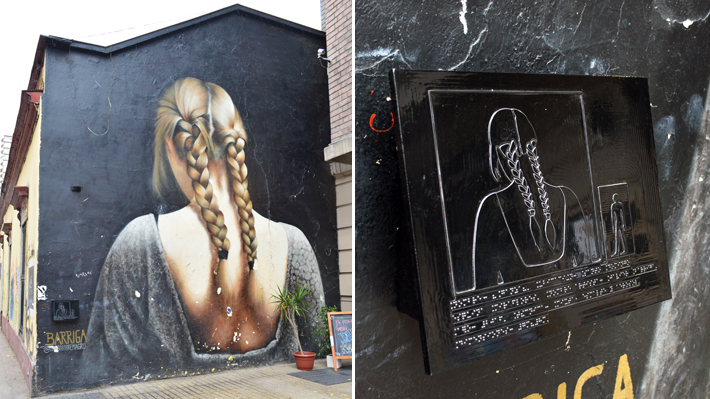
Javier Barriga, Ganza, Manos a la Pared exhibit
Cite
Hetherington, Kevin. “Accountability and Disposal: Visual Impairment and the Museum.” Museum and Society 1, no. 2 (2015): 104–15. https://doi.org/10.29311/mas.v1i2.18.
Kinsley, Rose Paquet. “Inclusion in Museums: a Matter of Social Justice.” Museum Management and Curatorship 31, no. 5 (2016): 474–90. https://doi.org/10.1080/09647775.2016.1211960.

ReplyDeleteHi Rachael! Thanks for sharing your thoughts. I love the picture that you included here. I think it's such a neat way to still try to share the beauty of the painting with those who cannot see it, but can experience it in other ways!
You mentioned about museums not caring about those who are visually impaired and how the museums could sued for that. Do you think that sometimes it is a matter of budget in museums that things like this don’t get done? I wonder if reevaluating how museums spend their money could be helpful in making places more inclusive for everyone. I do agree though, it’s great to see both articles calling for change and I think there are a lot of people behind the movement at this point.
The picture you included from the Chilean exhibit is really interesting. Something the Hetherington article talks about it how often even displays designed for the blind are designed around visual information and rarely designed around the information that is unique to physical touch. Access is complicated, so many factors need to be considered, but I think it's worth figuring out.
ReplyDeleteHi Rachel, that is an incredible example of inclusion that you chose. You're right that there is no excuse for other museums not to exhibit artwork that people with disabilities can enjoy. It seems strange that since America is known as a melting pot that we are not more sensitive to inclusion and accessibility. We hold ourselves in high regard as being an advanced first world nation yet our institutions are still in a rigid state of white imperialism. Also I liked your comment about the big museums that a lot of us have never been to. It makes me wonder why that is? Is it because of geography or is it something else? Price, or under representation of our culture or genders? It makes you think and that is something that we as a younger generation can do for our society. Just think outside of ourselves and make changes where we can as artists and professionals.
ReplyDeleteI've never seen anything like the inclusivity of that placard. It's pretty astounding how people can see so many needs to be met and can apply innovation in such a small package to meet those needs. Seeing how this post talks about people feeling unwelcome, have you ever felt this way in a museum or have you witnessed someone being treated with prejudice? If so please tell us in the article so we can get a better view of the injustices of museums.
ReplyDelete