Week 5:Exhibitions
So many images can pop into one’s mind when the word colonization
is said. Violence that turned into wars with the native population. Thievery of
one’s way of life if not just their lives. Reeducation of morals and beliefs to
match the invaders way of thinking. With the changes of thinking it has shaped
into one way of thinking. It has focused others into a perspective of not
belonging or even existing narrowed the terms and movements of what things can
mean and provided to one’s own life. This has all been done through colonization.
It has harmed everyone in the process of being educated and empathetic.
Decolonization of power, knowledge, being is the argument of Walter Mignolo in “Museums
in the Colonial Horizon of Modernity: Fred Wilson’s Mining the Museums (1992).”
Mignolo wants denial of the past and blissful ignorance to be removed formed the
system of museums, but also, from everything else. Museums are experienced
through the eyes of white Eurocentric definitions. This had placed the Natives
not into contemporary art museum but of natural science. To see Native Americans
as primitive and nonexistence. Because people do not want to be reminded of immoral
and unjust treatment that their ancestors are capable of. Instead people need to
look at Hellenistic sculptors and think civilization even though it was during
the same time period. Decolonization is facing the fact other events took place
other than the first thoughts that appears in someone’s mind. Mingnolo describes
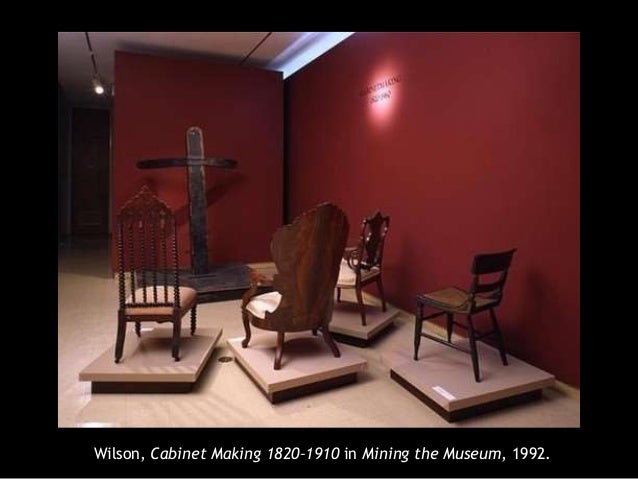
Fred Wilson exhibition,
In Cabinetmaking, he exhibited a
set of four wonderful antique chairs, most likely from the nineteenth century,
belonging to wealthy Baltimore families. He arranged them as one can imagine
they might have been arranged for a piano soirée during an evening in the
spring. The imaginary guests of that soirée are elegantly seated on the chairs,
as if they were facing an accomplished pianist, or perhaps a poet, from the
distinguished elite of Washington, DC. Instead, for their entertainment, Fred
Wilson placed a whipping post, a gift to the Baltimore Historical Society, from
the Baltimore City Jail Board.
An example of what decolonization
thinking looks like. Chimamanada Ngozi Adichie said in a ted talk that have a single
story dehumanizes the person, it removes their dignity. Fred Wilson did give dignity
when he displays beautiful antique chairs participating in a whipping. It does
not seem that way when the antique chairs are committing dehumanizing acts. The
installation compels the viewer to see that the two stories are happening. Two stories coexist. They happened at the same
time in the same place and witnessed by someone. Museums are not giving the complete
humanization of people and objects. They
continue to display exhibition as separate. Instead they are hiding behind the narrative
of being their power given to them by the thought and power of colonization.


What do you think museums should be doing to give more than a single story perspective on things? Going off of what I've seen from Colorado museums, it tends to just be a simple display with a description of what it is.
ReplyDeleteIt is a powerful thought that these stories coexist. Decolonization has separated these stories as if they happened in separate times and places. These shocking arrangements of artifacts to show how the stories coexist are necessary to start the conversation. How do you think other museums could show their current collections to fight against decolonization?
ReplyDelete