Week 4: High and Low
In 1936 society seemed to be changing for the worse in the eyes of Clement Greenberg. Traditions are being unmaintained or even thought of. Artists are no longer looking at their predecessors to label their art as art. Greenberg suggests that artists are no longer creating art in the traditional manner. They too have rejected themselves from society. Greenberg condemns Alexandrianism for it being a form of manufactured art. It is art that is being made but does not produce anything relevant to the culture. While condemning Alexandrianism he turns his attention to avant-garde art. He proclaims this art is almost the same in not offering something new. But gives avant-garde more praises because it moved society. Avant-garde is art for art's sake because art is on its own terms.
Through this art movement nonrepresentational art was on the rise. Greenberg said ,“the
avant-garde poet or artist tries to effect to imitate God by creating something valid solely on its own terms, in the way nature itself is valid, in the way a landscape – not its picture is aesthetically valid. Trying to make artists equal to God is an
absurd attempt on Greenberg's part. All artists are making something through their interpretation of what is aesthetically pleasing. Not just avant-garde artists created images of
themselves with only them in mind. Where the
imitating God theory falls apart is when art has no objective. But God created for a reason. This
is shown in
Greenberg's saying, “in turning his attention away from subject
matter of common experience,
the poet or artist turns it in
upon the medium of
his craft.” The only tie to
God the avant- garde artist have is the willingness to give the viewer free will in
what it means to
them. God and artists give one person a
say in what their creation means, and it only applies to
that one person. The opinion of the viewer means nothing to the creator. Because only the creator knows the true meaning. So, avant-garde artists allow free will as a judgment of
their paintings. Also, avant-garde artists are forgiving towards their
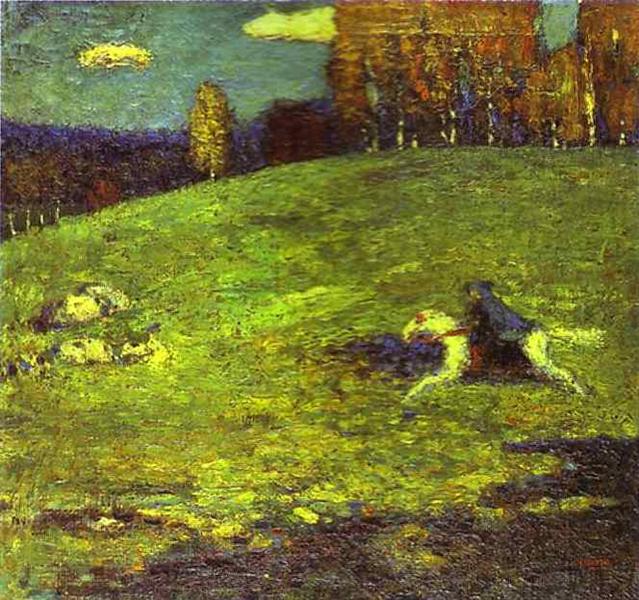
viewer's judgment being wrong. A trait of God. Yet, it does not make artists God. A trait is not the same has being the whole thing. An artist that allows their viewer to have an option in their work is, Vasily Kandinsky. The Blue Rider offered the audience a
say is in the artwork. Kandinsky
painted this piece but gives others the thought the rider was a child. He never told
people weather the idea was
right or not. Kandinsky gave them room to formulate their ideas and what the painting has inside of it.
Greenberg, Clement. “Avant-Garde and Kitsch,” 2015. http://sites.uci.edu/form/files/2015/01/Greenberg-Clement-Avant-Garde-and-Kitsch-copy.pdf.


This is a very thorough analysis and breakdown of Greenberg's argument and I commend you on your writing style as well. I like how often you tied back to the text to explain each of his important points. I think what's missing, however, is your personal stance on his beliefs. Do you agree with what he was saying about avant-garde art being the only true art?
ReplyDeleteThis comment has been removed by the author.
DeleteThank you, Laura,
DeleteI do not agree with Greenberg stance on Avant-garde art being the true form of art. I felt like Greenberg essay was very arrogant and condescending. There is a lot of “high” art that does not allow the viewer to think for themselves. The best example of the is historical art. The art pieces are only for documenting the moment and there is nothing more to them. So, Greenberg statement is false.
Hi Rachel, I really enjoyed reading your post and loved your : "Avant-garde is art for art's sake because art is on its own terms." Statement. I agree. Clearly Greenberg must have been touched by the Avant Garde because as you stated, he compared artists to god. You focused on the high form of art but did not mention much about kitsch. How come?
ReplyDeleteThank you, Ellen,
DeleteI did not mention Kitsch art because Greenberg did not see those artists as god. He felt like their art was a complete waste of time and space. I wanted to reflect on the self-righteous tone Greenberg has throughout his whole essay. I thought the best way to show his thinking that avant-garde artists as god was insane and focus on that one aspect.